

Broken Or Bent
1890s America reunified after Civil War - is there hope for us yet?

The White House last week released renderings of a proposed skyscraper that will house the Trump Presidential Library on Miami’s waterfront. But can you imagine the Trump Library on the left-wing campus of the University of California in Berkeley? Or envision Donald Trump Jr. and Gavin Newsom, walking the halls of Congress, shoulder to shoulder, as partners asking legislators for the same public project?
The modern mind struggles to posit such a scenario of bipartisan comity, America pulled it off once before, after 2.5 percent of our population had been killed off by their countrymen.
As divided as our algorithm-abetted culture war has made us, the split in mid-19th century America was worse, with schism and then secession begetting slaughter. Most national institutions split before the first shots were fired in the Civil War, and we still see some of that cleavage today, like the denominational demarcation between northern and Southern Baptists.
But sutures of outreach after the war slowly re-knitted America in ways that seem far-fetched to us now. A modern monument to that rebuilding is the unlikely location of the Ulysses S. Grant Presidential Library, on the campus of Mississippi State University in Starkville.
MSU’s President Dr. Mark Keenum told me and a group of visitors this past weekend that he often gets asked how the Union general, who put down the rebellion Mississippi helped start, ends up honored on that state’s flagship campus. “But Mississippi was the site of the events that elevated Grant’s career more than any other,” Keenum notes. By events, Keenum means the Illinoisan’s conquest on July 4, 1863 of Vicksburg, the river port that was the fulcrum of the South, a victory that, paired with Robert E. Lee’s defeat at Gettysburg the same week, determined the outcome of the war.
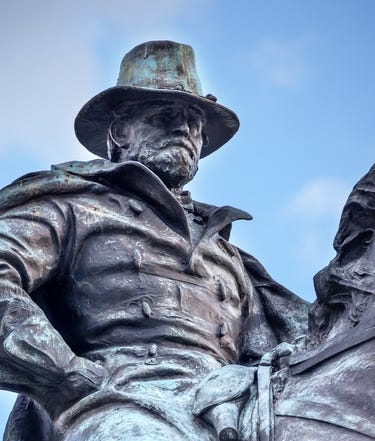
As every child educated in southern schools knows, the people of Vicksburg held out, living like rats in caves for month rather than surrender to the Yankee gunboats that shelled the town from the river and the infantry that surrounded it from behind. The Confederate artillery commander in Vicksburg resisting the siege was Gen. Stephen D. Lee, who Grant paroled upon his capture. Lee went on to an agricultural and political career that made him the first President of what is now Mississippi State University, a product of the Morrill Act signed during the war by President Abraham Lincoln creating a network of land grant universities.
“State,” as they call MSU today, is known for its engineering, horticulture, and business colleges, like most land grant schools. Buildings on campus hosting liberal arts disciplines exist, but on the campus’s edges, while the STEM and finance schools ring the main quadrangle. The Grant Presidential Library sits inside the school’s main library for now, but MSU is working on a grand stand-alone facility – smaller than Trump’s skyscraper but hopefully more elegant than the flimsy homage to Gerald Ford in Grand Rapids, Michigan.
Mississippi State got the Grant collection in 2009 when Southern Illinois University in the former President’s home state gave it up. A $10 million addition to the MSU library to house it was built a few years later, bridging to the permanent showpiece they are about to construct.
The university in Starkville was founded a year after the Grant Administration and the man himself never set foot on its Drill Field quad; his lone tie to MSU is Lee, the school’s founding president. Long after Grant paroled Lee at Vicksburg’s conquest, the former Confederate became close to Grant’s son, Frederick Dent Grant. The two men became the chief advocates for a national military park created in 1899 at Vicksburg to honor the soldiers on both sides who fought there. The younger Grant was a West Point man like his father, inspired by the three months he spent as a 13-year-old in the Vicksburg siege commander’s quarters.
Lee was succeeded as college president by another Confederate General, John M. Stone, who had helped Lee fight Grant to a draw in Virginia’s Wilderness Campaign. Thirty years after the war, Stone said Mississippians’ affection to Grant endured because of his commitment to reunification, words that now hang on the wall in the Grant library. “Next to those (Mississippi) officers we loved so well, General Grant is first in the hearts of the people of Mississippi.”
That spirit is why MSU is dedicated to expanding the Grant Library to an attraction. “We see this library as a statement of reconciliation,” Keenum told our group.
Keep reading with a 7-day free trial
Subscribe to The What For to keep reading this post and get 7 days of free access to the full post archives.